Citation

Wilson, A. E., D. C. Gossiaux, T. O. Höök, J. P. Berry, P. F. Landrum, J. Dyble, and S. J. Guildford. 2008. Evaluation of the human health threat associated with the hepatotoxin, microcystin, in the muscle and liver tissues of yellow perch (Perca flavescens). Canadian Journal of Fisheries and Aquatic Sciences 65(7):1487-1497.

Keywords

Link to Publication

Citation

Wilson, A. E. 2007. Journal impact factors are inflated. BioScience 57(7):550-551.

Abstract

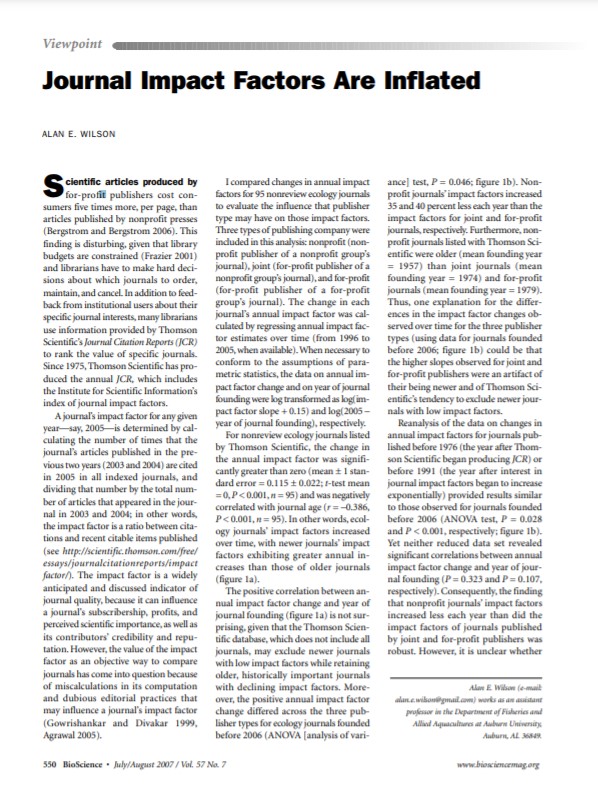
Scientific articles produced by for-profit publishers cost consumers five times more, per page, than articles published by nonprofit presses (Bergstrom and Bergstrom 2006). This finding is disturbing, given that library budgets are constrained (Frazier 2001) and librarians have to make hard decisions about which journals to order, maintain, and cancel. In addition to feedback from institutional users about their specific journal interests, many librarians use information provided by Thomson Scientific’s Journal Citation Reports (JCR) to rank the value of specific journals. Since 1975, Thomson Scientific has produced the annual JCR, which includes the Institute for Scientific Information’s index of journal impact factors.

Link to Publication

Citation

Wilson, A. E. and M. E. Hay. 2007. A direct test of cyanobacterial chemical defense: Variable effects of microcystin-treated food on two Daphnia pulicaria clonesLimnology and Oceanography 52(4):1467-1479.

Abstract

To determine the direct effects of microcystin on the fitness of herbivorous zooplankton, we experimentally added microcystin-LR to freeze-dried cells of palatable Chlorella and fed these compound-treated cells to two clones of Daphnia pulicaria that had shown differing responses to a diet containing a strain of Microcystis aeruginosa that produces microcystin. The Daphnia that performed better on a diet containing live Microcystis showed reduced population growth when exposed to microcystin-LR-treated Chlorella, whereas the Daphnia that performed poorly on the diet containing live Microcystis was not affected by the experimental diet containing microcystin-LR. This is the first study to unambiguously show that some Daphnia strains are and some strains are not harmed by the consumption of microcystin-LR. These surprising results were not generated by interference from lipophilic secondary metabolites in Microcystis. When the crude lipophilic extract of Microcystis was added to dried Chlorella cells, it enhanced the fitness of both Daphnia clones. We hypothesize that the Daphnia clone more tolerant to live cells may upregulate resistance when cued by the presence of the live Microcystis cells, but not by microcystin-LR alone. Alternatively, the Daphnia clone that grew well on a diet containing live Microcystis may sequester compounds from Microcystis that defend the cyanobacteria from autotoxicity; these compounds would have been unavailable to Daphnia consuming freeze-dried Chlorella treated with microcystin-LR alone. Thus, microcystin-LR can suppress Daphnia fitness when consumed; however, the effects of microcystin vary across clones of herbivorous zooplankton and the consequences of this variance should not be overlooked when considering zooplankton-cyanobacteria interactions.

Keywords

Link to Publication

Citation

Wilson, A. E., W. A. Wilson, and M. E. Hay. 2006. Intraspecific variation in growth and morphology of the bloom-forming cyanobacterium, Microcystis aeruginosaApplied and Environmental Microbiology 72(11):7386-7389.

Abstract

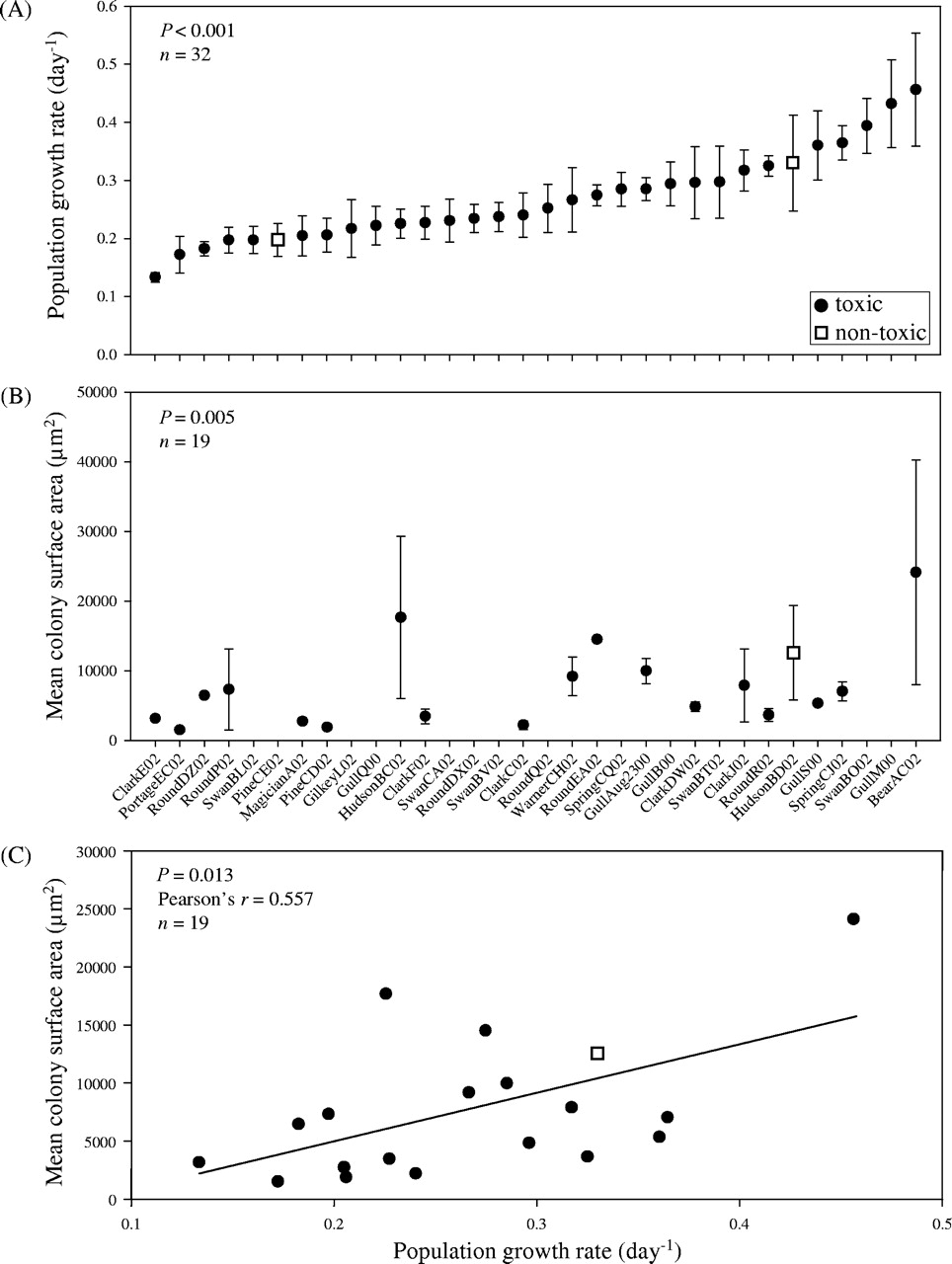
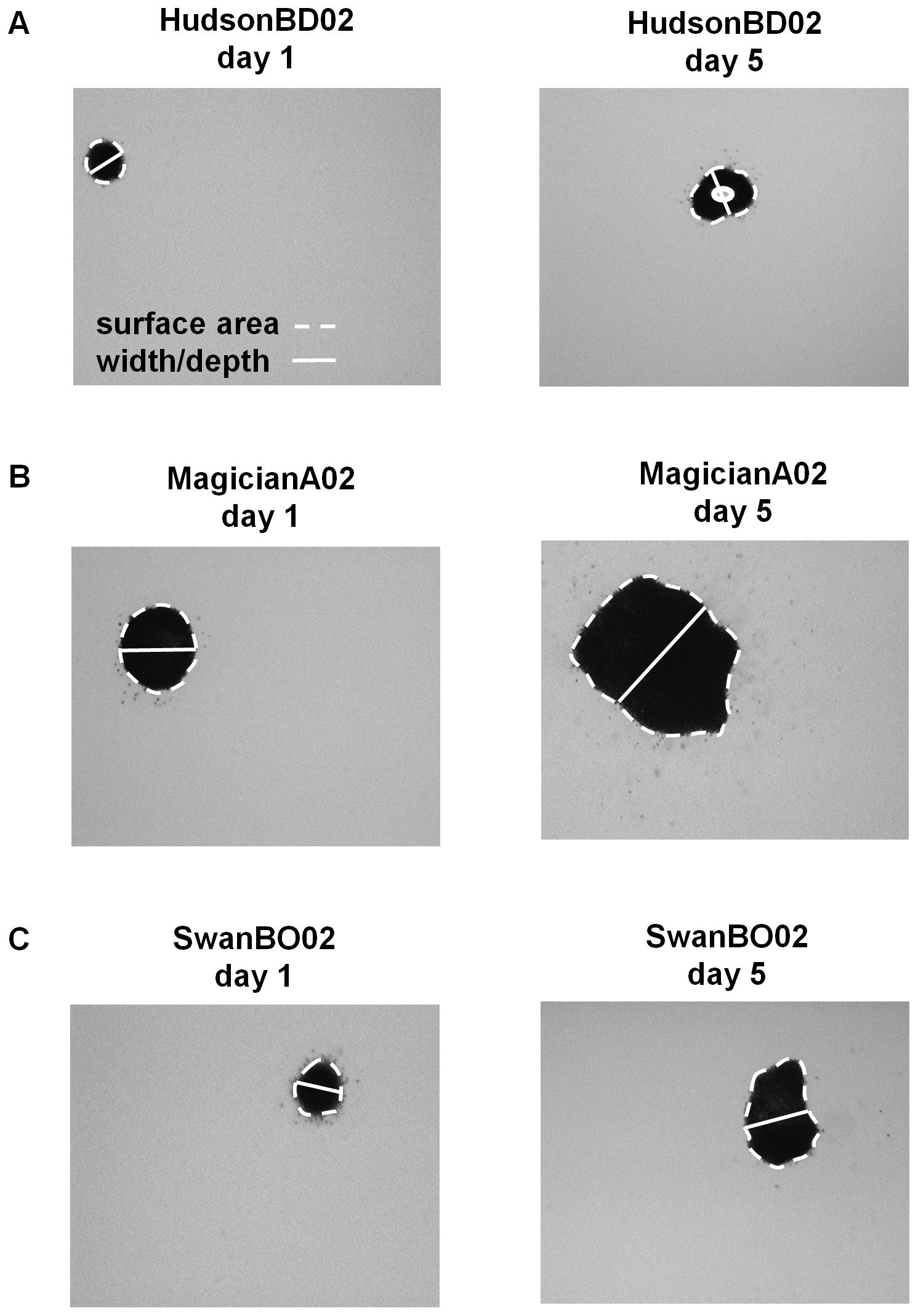
In the laboratory, we documented large variation in the morphology, toxicity, and maximum population growth rates for 32 Microcystis aeruginosa strains isolated from 12 lakes. Growth rates and mean colony sizes varied significantly across strains and were positively correlated. However, growth rates were unrelated to toxin production.

Keywords

Link to Publication

Citation

Wilson, A. E., O. Sarnelle, and A. R. Tillmanns. 2006. Effects of cyanobacterial toxicity and morphology on the population growth of freshwater zooplankton: Meta-analyses of laboratory experiments. Limnology and Oceanography 51(4):1915-1924.

Abstract

We synthesized data from 66 published laboratory studies, representing 597 experimental comparisons, examining the effects of cyanobacterial toxicity and morphology on the population growth rate and survivorship of 17 genera (34 species) of freshwater, herbivorous zooplankton. Two meta-analyses were conducted with these data. The primary analysis compared herbivore population growth rates for grazers fed treatment diets containing cyanobacteria versus control diets comprising phytoplankton that are generally considered to be nutritious for zooplankton (chlorophytes and/or flagellates). This analysis confirmed that cyanobacteria were poor foods relative to small chlorophytes and flagellates. More importantly, filamentous cyanobacteria were found to be significantly better foods for grazers than single-celled cyanobacteria over all studies. Surprisingly, the presence or absence of commonly-measured toxic compounds (microcystins in 70% of the cases) in the diet had no overall influence on grazer population growth relative to control diets. A secondary analysis compared survival rates for grazers fed cyanobacteria versus no food. In contrast to the primary analysis, grazer survival was more negatively affected by toxic cyanobacteria than non-toxic cyanobacteria, relative to starvation. However, this difference was attributable to the effects of a single Microcystis strain, PCC7820. Thus, though some cyanobacterial strains appear to be toxic to some strains of zooplankton, the overall role of commonly-assayed cyanobacterial toxins as a determinant of food quality may be less than widely assumed. We suggest that more attention be focused on nutritional deficiencies, morphology, and the toxicity of undescribed cyanobacterial compounds as mediators of the poor food quality of cyanobacteria for zooplankton.

Keywords

Link to Publication

Citation

Sarnelle, O. and A. E. Wilson. 2005. Local adaptation of Daphnia pulicaria to toxic cyanobacteria. Limnology and Oceanography 50(5):1565-1570.

Abstract

We quantified within-species variation in the tolerance of the large, lake-dwelling daphnid, Daphnia pulicaria, to toxic cyanobacteria in the diet. Juvenile growth rates on diets consisting of 100% Ankistrodesmus falcatus (a nutritious green alga) or 100% Microcystis aeruginosa (toxic) were compared for D. pulicaria clones isolated from lakes expected to have low and high levels of bloom-forming cyanobacteria during summer. Growth rates of clones isolated from high-nutrient lakes (range of total phosphorus, 31-235 °g L−1) were higher, and showed less relative inhibition, on the cyanobacterial diet compared to clones isolated from low-nutrient lakes (range of total phosphorus, 9-13 °g L-1). Our results suggest that D. pulicaria populations exposed to high cyanobacterial levels over long periods of time can adapt to being more tolerant of toxic cyanobacteria in the diet.

Keywords

Link to Publication

Citation

Wilson, A. E., O. Sarnelle, B. A. Neilan, T. P. Salmon, M. M. Gehringer, and M. E. Hay. 2005. Genetic variation of the bloom-forming cyanobacterium Microcystis aeruginosa within and among lakes: Implications for harmful algal blooms. Applied and Environmental Microbiology 71(10):6126-6133.

Abstract

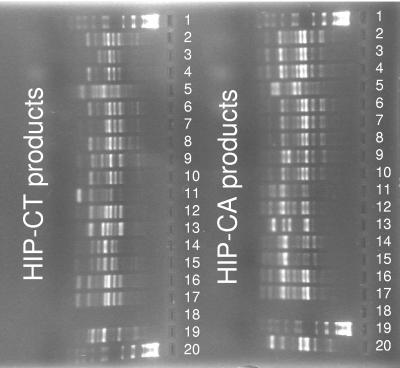
To measure genetic variation within and among populations of the bloom-forming cyanobacterium Microcystis aeruginosa, we surveyed a suite of lakes in the southern peninsula of Michigan that vary in productivity (total phosphorus concentrations of approximately 10 to 100 microg liter(-1)). Survival of M. aeruginosa isolates from lakes was relatively low (i.e., mean of 7% and maximum of 30%) and positively related to lake total phosphorus concentration (P = 0.014, r2 = 0.407, n = 14). In another study (D. F. Raikow, O. Sarnelle, A. E. Wilson, and S. K. Hamilton, Limnol. Oceanogr. 49:482-487, 2004), survival rates of M. aeruginosa isolates collected from an oligotrophic lake (total phosphorus of approximately 10 mug liter(-1) and dissolved inorganic nitrogen:total phosphorus ratio of 12.75) differed among five different medium types (G test, P of <0.001), with higher survival (P = 0.003) in low-nutrient media (28 to 37% survival) than in high-nutrient media. Even with the relatively low isolate survivorship that could select against detecting the full range of genetic variation, populations of M. aeruginosa were genetically diverse within and among lakes (by analysis of molecular variance, Phi(sc) = 0.412 [Phi(sc) is an F-statistic derivative which evaluates the correlation of haplotypic diversity within populations relative to the haplotypic diversity among all sampled populations], P = 0.001), with most clones being distantly related to clones collected from lakes directly attached to Lake Michigan (a Laurentian Great Lake) and culture collection strains collected from Canada, Scotland, and South Africa. Ninety-one percent of the 53 genetically unique M. aeruginosa clones contained the microcystin toxin gene (mcyA). Genotypes with the toxin gene were found in all lakes, while four lakes harbored both genotypes possessing and genotypes lacking the toxin gene.
Keywords

Link to Publication

Citation

Sarnelle, O., A. E. Wilson, S. K. Hamilton, L. B. Knoll, and D. F. Raikow. 2005. Complex interactions between the zebra mussel, Dreissena polymorpha, and the harmful phytoplankter, Microcystis aeruginosaLimnology and Oceanography 50(3):896-904.

Abstract

We report a reversal in the sign of the herbivore-phytoplankton interaction between the zebra mussel (Dreissena polymorpha) and Microcystis aeruginosa, a harmful planktonic cyanobacterium. A pair of large-scale manipulations of mussel density in the same lake in consecutive years showed that when phosphorus concentrations were very low (mean total phosphorus [TP] ~ 3 µg L−1), the effect of Dreissena on the biomass of M. aeruginosa was monotonically negative across the full range of sustainable mussel densities. When the enclosures were fertilized with phosphorus (mean TP ~ 9 µg L−1), there was a monotonically positive effect of Dreissena on M. aeruginosa across the same mussel gradient. These contrasting results indicate that D. polymorpha feeds on M. aeruginosa, as shown in previous laboratory feeding experiments, but that the positive effects of D. polymorpha on M. aeruginosa can be larger than the negative effects of consumption. A sign reversal in the interaction between these two species is congruent with highly variable patterns in the response of M. aeruginosa to D. polymorpha invasion across lake and river systems in North America.

Keywords

Link to Publication

Citation

Raikow, D. F., O. Sarnelle, A. E. Wilson, and S. K. Hamilton. 2004. Dominance of the noxious cyanobacterium Microcystis aeruginosa in low-nutrient lakes is associated with exotic zebra mussels. Limnology and Oceanography 49(2):482-487.

Abstract

To examine the hypothesis that invasion by zebra mussels (Dreissena polymorpha) promotes phytoplankton dominance by the noxious cyanobacterium Microcystis aeruginosa, 61 Michigan lakes of varying nutrient levels that contain or lack zebra mussels were surveyed during late summer. After accounting for variation in total phosphorus (TP) concentrations, lakes with Dreissena had lower total phytoplankton biomass, as measured by chlorophyll a and algal cell biovolume. Phytoplankton biomass increased with TP in both sets of lakes, although the elevations of the relationship differed. The percentage of the total phytoplankton comprised by cyanobacteria increased with TP in lakes without Dreissena (R2 = 0.21, P = 0.025) but not in lakes with Dreissena (P = 0.79). Surprisingly, there was a positive influence of Dreissena invasion on Microcystis dominance in lakes with TP ≪ 25 µg L−1 (P 5 0.0018) but not in lakes with TP ≫ 25 µg L−1 (P = 0.86). The finding that Microcystis, a relatively grazing-resistant component of the phytoplankton, was favored by Dreissena in low- but not in high-nutrient lakes is somewhat counterintuitive, but predator-prey models make this prediction in certain cases when the cost for the prey of being consumption resistant is a low maximum population growth rate. This Dreissena-cyanobacteria interaction contradicts well-established patterns of increasing cyanobacteria with nutrient enrichment in north-temperate lakes and suggests that the monitoring and abatement of nutrient inputs to lakes may not be sufficient to predict and control cyanobacterial dominance of Dreissena-invaded lakes.

Keywords

Link to Publication